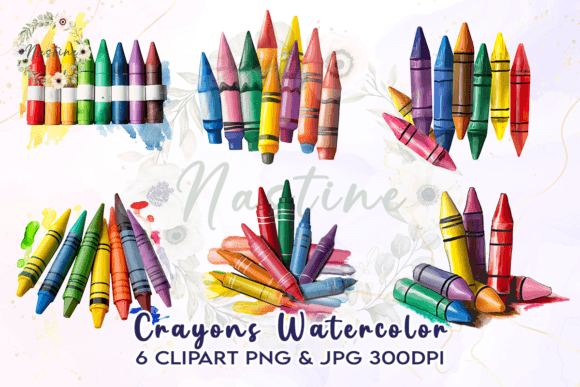
Back to School Pencils Watercolor: A Practical Digital Asset for Educators and Creative Professionals
Back to School Pencils Watercolor is a high-resolution digital design set that delivers authentic, hand-painted pencil illustrations in watercolor style—ideal for educators, small business owners, print-on-demand creators, and marketing professionals developing seasonal or academic-themed materials. Unlike generic clipart or AI-generated vectors, this collection emphasizes organic texture, soft pigment blending, and natural paper grain, lending visual warmth and credibility to printed and digital projects alike.
What You Receive—and Why It Matters
The package includes both PNG and JPG files at 4000×4000 px resolution, rendered at 300 DPI in RGB color mode. The transparent background (available in PNG only) allows seamless layering over photos, gradients, or textured substrates without clipping masks or manual cleanup. This isn’t just about pixel count—it’s about scalability without visible degradation, whether you’re printing a 24×36″ classroom poster or resizing for a social media banner.
No watermark appears on downloaded files, eliminating post-purchase editing steps. That transparency extends beyond the background: the creator clearly states technical requirements—including matching software color mode (RGB) and output settings (300 DPI)—which reflects an understanding of real-world production workflows. This level of specificity signals reliability, especially for users who regularly prepare files for professional printers or sublimation systems.
Real-World Usability Across Mediums
Back to School Pencils Watercolor performs well where many digital assets falter: consistency across physical outputs. Because it’s built in RGB at 300 DPI, it aligns with standard digital printing, dye-sublimation, and inkjet workflows—provided users adjust their software accordingly. For example, when applied to ceramic mugs via sublimation, the watercolor softness translates into subtle, non-digital-looking results, avoiding the harsh edges common with low-res or CMYK-mismatched files.
It also adapts cleanly to layered digital uses. In Canva or Adobe Illustrator, the transparent PNG drops easily into templates for back-to-school newsletters, parent welcome packets, or digital planner stickers. For vinyl decal cutting, the high contrast between pencil graphite and watercolor wash ensures clean vector tracing—though users should still perform test cuts on their specific machine and material.
Where some watercolor-style assets suffer from oversaturation or inconsistent opacity, this set maintains balanced tonal range. Lighter washes retain detail; darker pencil strokes hold definition without bleeding into adjacent areas. That balance supports legibility—even at smaller sizes—when used on items like notebook covers or student name tags.
Audience Fit: Who Benefits Most?
Educators designing classroom décor, welcome signs, or printable behavior charts gain immediate utility. The nostalgic, tactile quality of watercolor pencils resonates with early childhood and elementary audiences while remaining professional enough for staff handbooks or school-wide communications.
Small business owners running print shops, Etsy stores, or craft supply brands find flexibility here. A single Back to School Pencils Watercolor file can serve multiple SKUs: heat-pressed onto cotton tees, screen-printed on tote bags, or embedded into SVG bundles for Cricut users. Its versatility reduces the need to license multiple themed sets—streamlining inventory and design time.
Freelance designers and marketers building seasonal campaigns (e.g., August “new beginnings” email series or academic-year social content) appreciate the cohesive aesthetic. Rather than stitching together mismatched icons, they can rely on a unified visual language—soft blues, muted yellows, warm grays—that reads as intentional, not algorithmically assembled.
Technical Considerations and Limitations
Color variance across monitors remains unavoidable—and the listing rightly notes this. What appears as a gentle sage green on one display may read slightly cooler on another. That’s not a flaw in the file but a constraint of RGB rendering and hardware calibration. Users preparing for offset printing should convert to CMYK *after* final layout and conduct press checks, rather than assuming on-screen fidelity.
The absence of vector formats (e.g., EPS or SVG) limits infinite scalability for large-format signage or embroidery digitizing. While 4000×4000 px covers most use cases—including 24×36″ prints at 300 DPI—the asset isn’t suited for billboards or stadium banners requiring 100+ megapixel resolution.
Sublimation use requires more than file access: it assumes familiarity with heat press timing, temperature curves, and substrate compatibility. The listing correctly emphasizes that the file alone doesn’t guarantee success—just as a high-quality violin won’t produce music without technique. This honesty helps manage expectations and filters for users who understand their tools.
Workflow Integration and Long-Term Value
Because all files are delivered in widely supported formats and organized without nested folders or licensing restrictions, integration into existing creative pipelines is frictionless. Designers using Affinity Photo, Procreate, or Photoshop can open, resize, and export without conversion delays. Educators using Google Slides or Microsoft PowerPoint benefit from drag-and-drop compatibility—especially with the transparent PNG for overlaying text or photos.
Long-term value emerges in reusability. A single Back to School Pencils Watercolor element can be recolored, masked, or composited into new layouts year after year—supporting recurring themes without visual fatigue. Unlike trend-dependent graphics (e.g., neon gradients or exaggerated 3D effects), its watercolor realism has enduring appeal across age groups and contexts.
For teams managing brand guidelines, the consistent texture and palette support visual continuity. When paired with complementary fonts (e.g., a clean sans-serif for headings and a gentle script for accents), it forms a recognizable identity system—valuable for schools updating their communication standards or tutoring services building client trust through cohesive materials.
Final Assessment: When Back to School Pencils Watercolor Fits—and When It Doesn’t
This isn’t a universal solution for every back-to-school project. If your work demands photorealistic photography, editable vector paths, or multi-language text overlays baked into the design, look elsewhere. But if your priority is authentic, printable-ready illustration that bridges handmade charm with digital precision—Back to School Pencils Watercolor delivers measurable utility.
Its strength lies in execution, not novelty: thoughtful resolution, honest technical documentation, and aesthetic cohesion. For professionals who treat design assets as working tools—not decorative afterthoughts—it earns its place in a curated resource library. Whether you’re prepping lesson plans, launching a teacher merch line, or refreshing your education-focused blog’s visual tone, it offers reliable starting points—not shortcuts.